Hui Wang
wanghehv@sjtu.edu.cn

🚨 I am currently on the job market for a full-time position. Please feel free to reach out via wanghehv@sjtu.edu.cn.
I am a final-year Ph.D. candidate at Shanghai Jiao Tong University, advised by Prof. Xubo Yang at Digital ART Laboratory. I had the privilege of working closely with Prof. Bo Zhu of Georgia Tech.
My research interests include computer graphics, physics-based simulation, neural simulation, virtual reality and neuro-physical hybrid modeling. Prior to my Ph.D. journey, I earned my Master’s and Bachelor’s degrees from Shanghai Jiao Tong University.
news
| Jun 23, 2026 | Our papers DiffSurFlow and Two-phase Impulse Fluid on Particle Flow Map have been accepted to SIGGRAPH 2026 and TVCG, respectively.  |
|---|---|
| Jun 18, 2026 | Our collaborative papers SoMA (ICML), Tac2Real (ECCV) and Sim1 (ECCV) are accepted. |
| Aug 24, 2024 | I was honored to join a CCF talk discussing the game “Black Myth: Wukong” as a player and graphics researcher. |
| Aug 23, 2024 | Our work on walking droplets has been accepted by International Journal for Numerical Methods in Engineering (IJNME). |
| Jun 28, 2024 | We maintain an awesome list of neural physics simulation. Feel free to explore it! |
selected publications
-
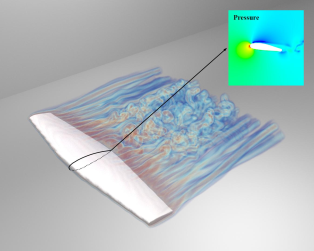 DiffSurFlow: Efficient and Robust Differentiable Fluid Optimization via Surrogate Strategy on Flow MapYuhao Quan, Hui Wang, Weile Lian, Zhi Wang, and Xubo YangACM Trans. Graph., Jul 2026
This paper presents a highly efficient and robust differentiable fluid framework, centered on a novel surrogate gradient method that utilizes the flow map structural advantages. Our key insight reveals a significant misalignment between computational intensity and gradient importance during the backward pass. Specifically, we identify a physical duality within the adjoint process, revealing that the cross-step connections inherent in the flow map act as dominant gradient "highways" that propagate sensitivities over long horizons with high fidelity. Leveraging these insights, we develop a surrogate gradient model that retains these critical connections while pruning redundant adjoint computations in a physics-informed manner. Integrated with tailored acceleration techniques, our framework is successfully applied to diverse, challenging optimization tasks characterized by long time horizons and rich vorticity. Results demonstrate significant speedups and memory reductions while maintaining nearly-identical gradients compared to the full-gradient baseline.
@article{quan2026diffsurflow, title = {DiffSurFlow: Efficient and Robust Differentiable Fluid Optimization via Surrogate Strategy on Flow Map}, author = {Quan, Yuhao and Wang, Hui and Lian, Weile and Wang, Zhi and Yang, Xubo}, journal = {ACM Trans. Graph.}, issue_date = {July 2026}, publisher = {Association for Computing Machinery}, address = {New York, NY, USA}, volume = {45}, number = {4}, issn = {0730-0301}, articleno = {66}, numpages = {28}, pages = {1--28}, month = jul, year = {2026}, doi = {10.1145/3811337}, url = {https://doi.org/10.1145/3811337}, } -
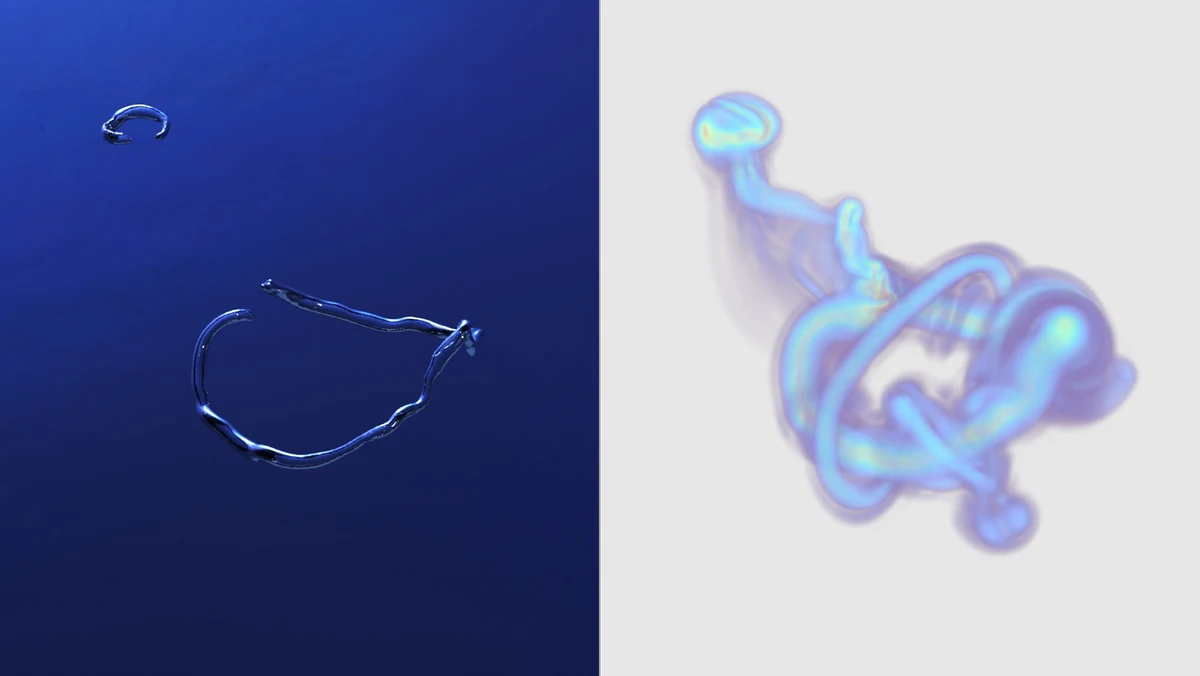 Two-phase Impulse Fluid on Particle Flow MapHui Wang, Jinjin He, and Xubo YangIEEE Transactions on Visualization & Computer Graphics, Jul 2026
We present a novel particle flow map framework for the high-fidelity simulation of complex two-phase flows. Our method is built upon a unified Lagrangian formulation in which a shared flow map jointly governs the phase interface evolution and the underlying fluid dynamics. For interface tracking, our particles drive a particle-flow-map-based level set equipped with a hybrid reinitialization strategy, effectively preserving sub-grid geometric features while ensuring robust topological stability. For two-phase dynamics, we introduce an impulse-based solver that reformulates the impulse path integration to depend solely on the continuous velocity field, enabling efficient and accurate handling of interfacial discontinuities without artificial smoothing. By leveraging the particle flow map’s inherently low-dissipation tracking of both geometry and dynamics, our framework achieves enhanced geometric accuracy and physical fidelity relative to existing two-phase solvers. Our framework faithfully captures the intricate interplay between intense vortical motion and complex interface geometry, as evidenced by the reproduction of a broad range of challenging phenomena, including interacting bubble rings, breaking waves, and whirlpool drainage.
@article{wang2026two, title = {Two-phase Impulse Fluid on Particle Flow Map}, author = {Wang, Hui and He, Jinjin and Yang, Xubo}, journal = {IEEE Transactions on Visualization \& Computer Graphics}, number = {01}, issn = {1941-0506}, pages = {1--17}, month = jul, year = {2026}, doi = {10.1109/TVCG.2026.3709951}, note = {}, url = {https://doi.ieeecomputersociety.org/10.1109/TVCG.2026.3709951}, publisher = {IEEE Computer Society}, address = {Los Alamitos, CA, USA}, keywords = {Fluid flow; Elementary particles; Fluids; Level set; Simulation; Surfaces; Evolution (biology); Tracking; Timing; Dynamics}, } -
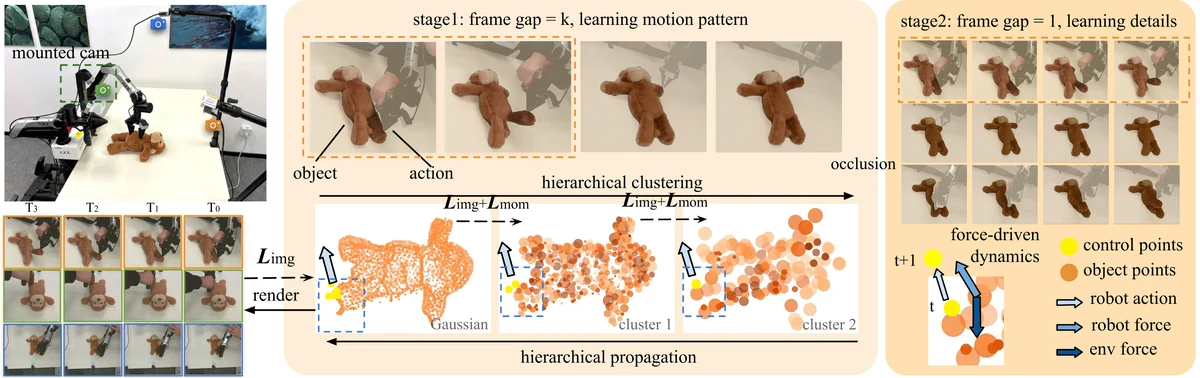 SoMA: A Real-to-Sim Neural Simulator for Robotic Soft-body ManipulationMu Huang, Hui Wang, Kerui Ren, Linning Xu, Yunsong Zhou, Mulin Yu, Bo Dai, and Jiangmiao PangIn International Conference on Machine Learning (ICML), Jul 2026
@inproceedings{huang2026soma, title = {SoMA: A Real-to-Sim Neural Simulator for Robotic Soft-body Manipulation}, author = {Huang, Mu and Wang, Hui and Ren, Kerui and Xu, Linning and Zhou, Yunsong and Yu, Mulin and Dai, Bo and Pang, Jiangmiao}, booktitle = {International Conference on Machine Learning (ICML)}, month = jul, year = {2026}, url = {https://arxiv.org/abs/2602.02402}, } -
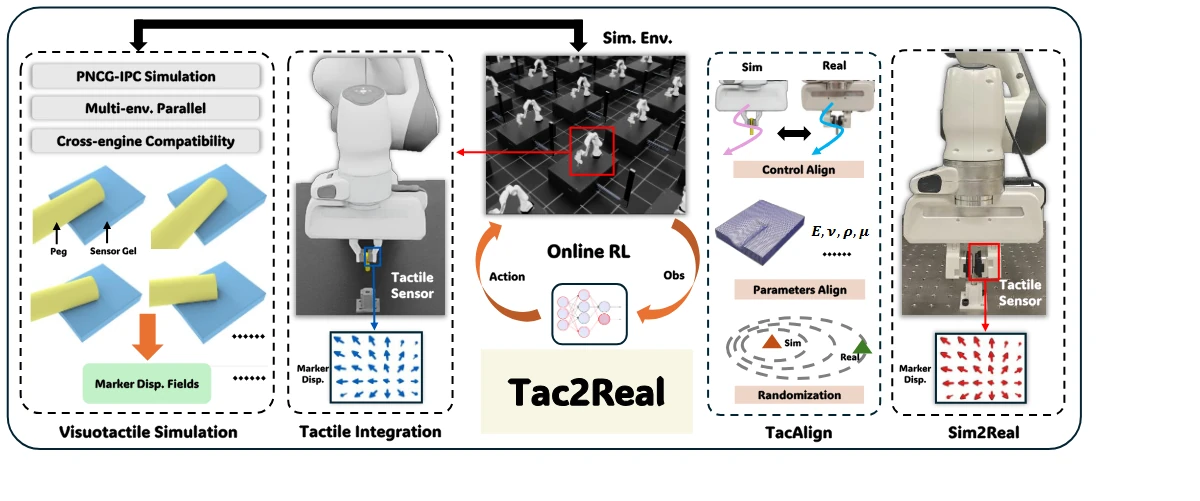 Tac2Real: Reliable and GPU Visuotactile Simulation for Online Reinforcement Learning and Zero-Shot Real-World DeploymentNingyu Yan, Shuai Wang, Xing Shen, Hui Wang, Hanqing Wang, Yang Xiang, and Jiangmiao PangarXiv, Mar 2026
@article{yan2026tac2real, title = {Tac2Real: Reliable and GPU Visuotactile Simulation for Online Reinforcement Learning and Zero-Shot Real-World Deployment}, author = {Yan, Ningyu and Wang, Shuai and Shen, Xing and Wang, Hui and Wang, Hanqing and Xiang, Yang and Pang, Jiangmiao}, journal = {arXiv}, month = mar, year = {2026}, url = {https://arxiv.org/abs/2603.28475}, } -
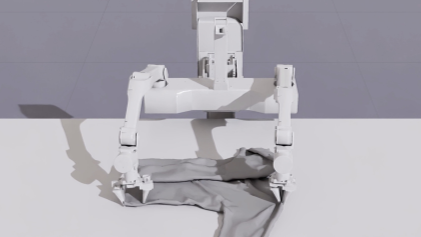 SIM1: Physics-Aligned Simulator as Zero-Shot Data Scaler in Deformable WorldsYunsong Zhou, Hangxu Liu, Xuekun Jiang, Xing Shen, Yuanzhen Zhou, Hui Wang, Baole Fang, Yang Tian, Mulin Yu, Qiaojun Yu, and 5 more authorsarXiv, Apr 2026
@article{zhou2026sim1, title = {SIM1: Physics-Aligned Simulator as Zero-Shot Data Scaler in Deformable Worlds}, author = {Zhou, Yunsong and Liu, Hangxu and Jiang, Xuekun and Shen, Xing and Zhou, Yuanzhen and Wang, Hui and Fang, Baole and Tian, Yang and Yu, Mulin and Yu, Qiaojun and Ma, Li and Li, Hengjie and Wang, Hanqing and Zeng, Jia and Pang, Jiangmiao}, journal = {arXiv}, month = apr, year = {2026}, url = {https://arxiv.org/abs/2604.08544}, } -
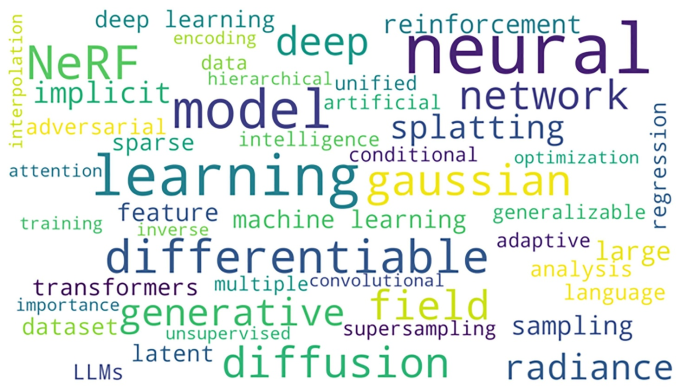 Artificial intelligence for virtual reality: a reviewLili Wang, Weiwei Xu, Yebin Liu, Miao Wang, Beibei Wang, Xubo Yang, Lan Xu, Zhangyao Tan, Runze Fan, Zijun Wang, and 11 more authorsScience China Information Sciences, Sep 2025
As hardware and information technology continually advance, virtual reality (VR) has permeated numerous sectors, with applications becoming increasingly sophisticated. The evolution of VR systems has expanded from the seminal 3I characteristics—immersion, interaction, and imagination—to encompass 6I, incorporating intelligentization, interconnection, and iteration. The intelligentization of VR technology, an inevitable progression, has garnered heightened interest, particularly fueled by the emergence of artificial intelligence (AI) models and techniques like neural radiance fields, 3D Gaussian Splatting, neural rendering, generative adversarial networks, diffusion models, and large language models, which significantly propel the development of VR’s core and pivotal technologies. This survey offers a comprehensive assessment of these pivotal VR technologies, harnessing the latest AI advancements, aiming to provide fresh perspectives and assist new researchers in staying abreast of groundbreaking work. We commence by detailing the acquisition process of reviewed papers, outlining our taxonomy grounded in VR’s core elements and pivotal technological trajectories, and statistically analyzing the works within. Subsequently, we delve into the application of AI models, methodologies, and techniques across six research avenues: advanced AI-generated content representation, content rendering, content generation, physical simulation, virtual characters, and interaction, discussing their achievements. Concludingly, we summarize our findings, highlight existing challenges, and suggest potential avenues for future research.
@article{wang2025artificial, title = {Artificial intelligence for virtual reality: a review}, author = {Wang, Lili and Xu, Weiwei and Liu, Yebin and Wang, Miao and Wang, Beibei and Yang, Xubo and Xu, Lan and Tan, Zhangyao and Fan, Runze and Wang, Zijun and Wang, Chi and Zhang, Hongwen and Wen, Yijian and Yang, Haozhong and Wu, Jian and Fan, Jiahui and Wang, Hui and Zhang, Qixuan and Wang, Guoping and Wang, Yongtian and Zhao, Qinping}, journal = {Science China Information Sciences}, volume = {69}, number = {1}, pages = {111101}, month = sep, year = {2025}, doi = {10.1007/s11432-024-4541-9}, url = {https://link.springer.com/article/10.1007/s11432-024-4541-9}, dimensions = {true}, } -
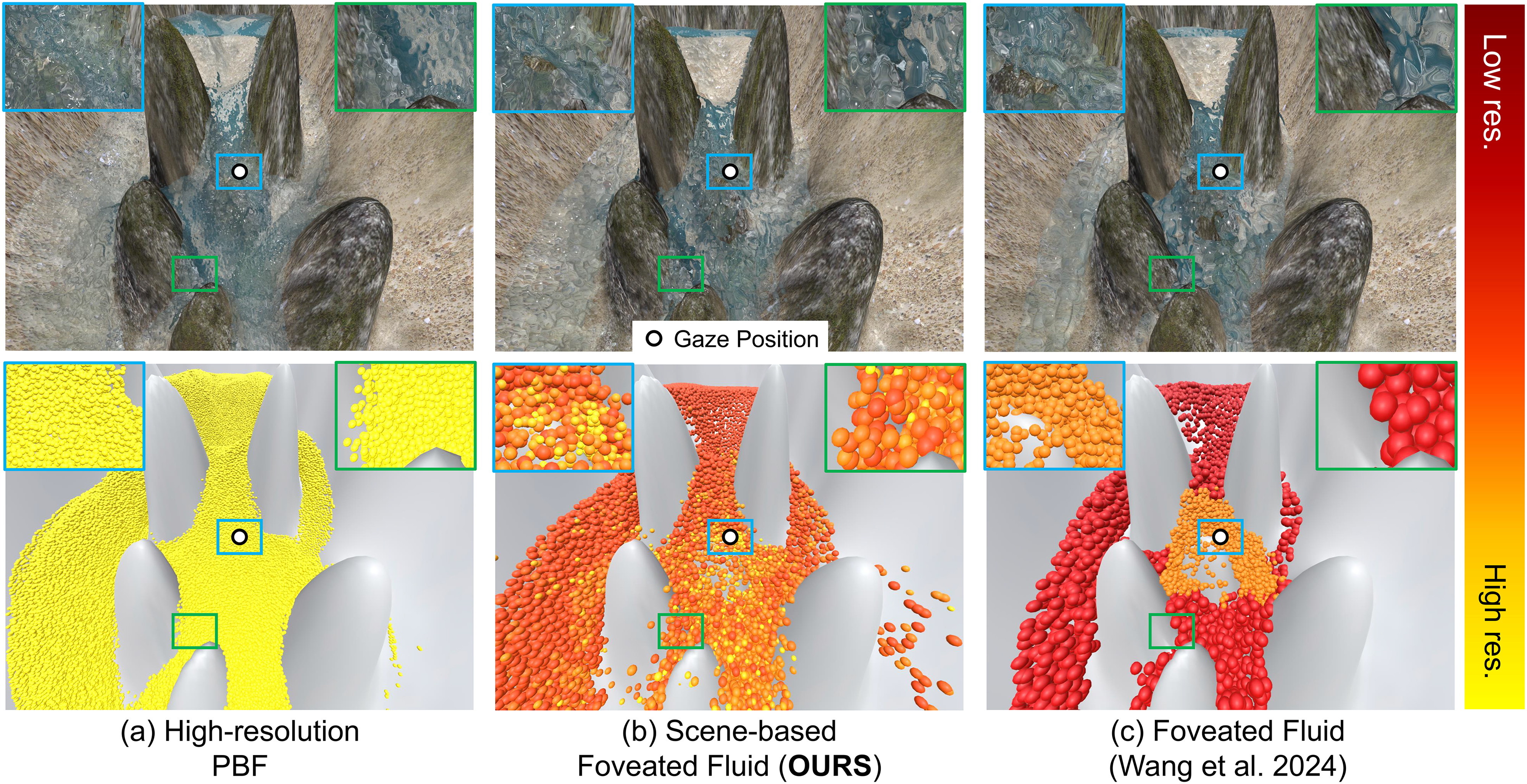 Scene-Based Foveated Fluid Animation in Virtual RealityYue Wang, Yan Zhang, Xuanhui Yang, Hui Wang, and Xubo YangIEEE Trans. Vis. Comput. Graph., Sep 2025
Physically-based fluid animation in Virtual Reality (VR) significantly enhances the user experience through visually engaging flow motions. Nonetheless, such simulations are often limited by their substantial computational demands. A tailored adaptive simulation algorithm is important for high-performance VR fluid simulations, which dynamically allocate degrees of freedom (DoF) while accounting for user perception in VR. This paper proposes a novel scene-based gaze-contingent fluid simulation system for VR, featuring a highly adaptive fluid simulator integrated with a VR perceptual model that accounts for the foveation and geometry of fluid. Our method leverages an eccentricity and curvature-dependent perceptual model to dynamically allocate computational resources, improving the efficiency and maintaining spatio-temporal stability of fluid animation in VR. A user study was conducted to measure the simulation resolution thresholds for fluid animations in VR, considering various levels of eccentricity and curvature. Our findings indicate notable differences in perceptual thresholds based on these metrics. By incorporating these insights into our adaptive fluid simulator as a unified sizing function, we maintain perceptually optimal particle resolution, achieving up to a 3.62x performance improvement while delivering superior perceptual realism and user experience, as validated by a subjective evaluation study.
@article{wang2025scene, title = {Scene-Based Foveated Fluid Animation in Virtual Reality}, author = {Wang, Yue and Zhang, Yan and Yang, Xuanhui and Wang, Hui and Yang, Xubo}, journal = {IEEE Trans. Vis. Comput. Graph.}, year = {2025}, volume = {31}, number = {12}, pages = {10667-10680}, keywords = {Fluids;Adaptation models;Computational modeling;Animation;Visualization;Solid modeling;Real-time systems;Liquids;Fluid dynamics;Rendering (computer graphics);Adaptive fluid animation;foveated graphics;physical simulation;virtual reality}, doi = {10.1109/TVCG.2025.3609904}, url = {https://ieeexplore.ieee.org/abstract/document/11175366}, dimensions = {true}, } -
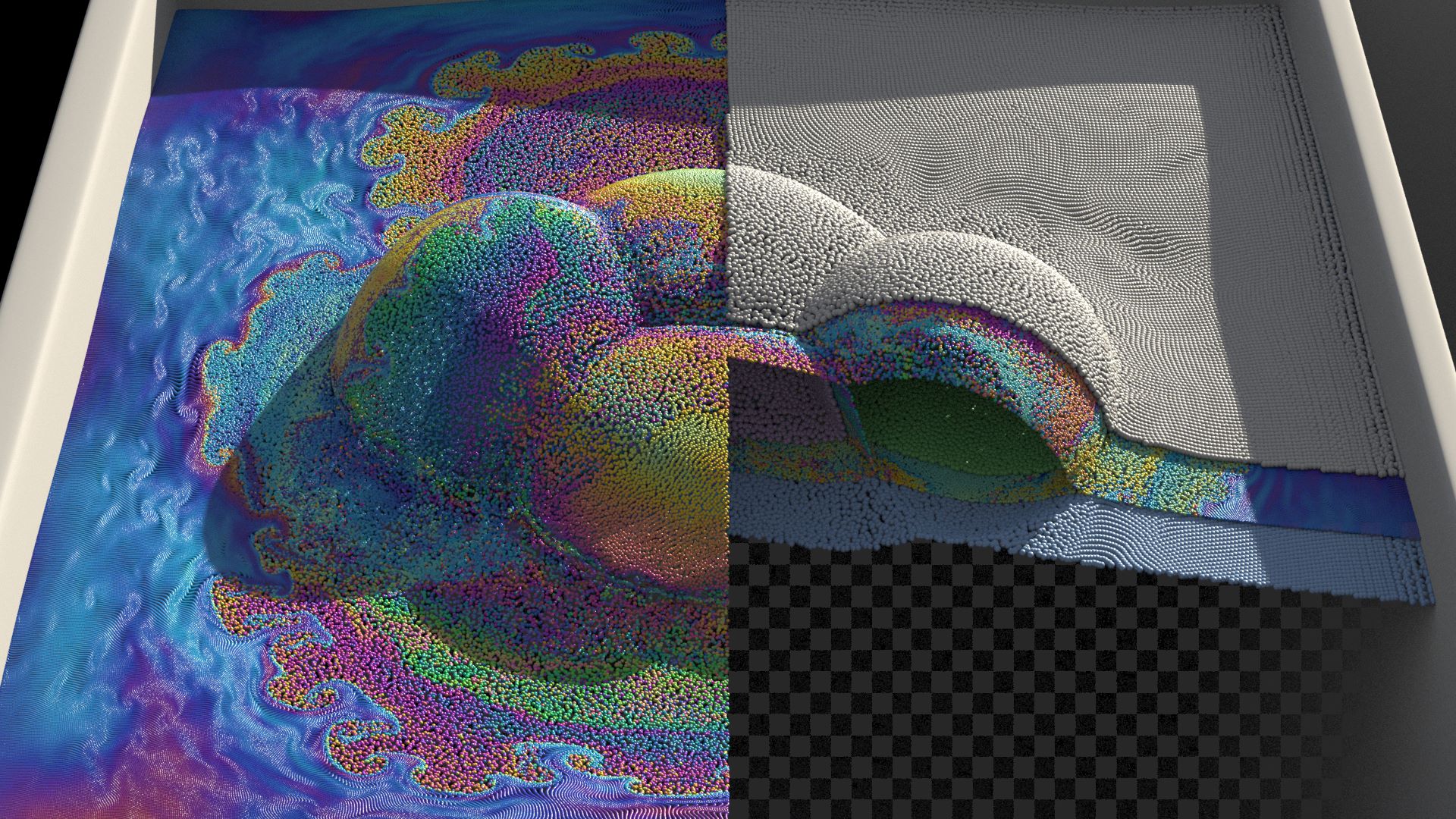 A Moving Least-Squares/Level-Set Particle Method for Bubble and Foam SimulationHui Wang, Zhi Wang, Shulin Hong, Xubo Yang, and Bo ZhuIEEE Trans. Vis. Comput. Graph., Sep 2024
We present a novel particle-grid scheme for simulating bubble and foam flow. At the core of our approach lies a particle representation that combines the computational nature of moving least-squares particles and particle level-set methods. Specifically, we assign a dedicated particle system to each individual bubble, enabling accurate tracking of its interface evolution and topological changes in a foaming fluid system. The particles within each bubble’s particle system serve dual purposes. Firstly, they function as a surface discretization, allowing for the solution of surfactant flow physics on the bubble’s membrane. Additionally, these particles act as interface trackers, facilitating the evolution of the bubble’s shape and topology within the multiphase fluid domain. The combination of particle systems from all bubbles contributes to the generation of an unsigned level-set field, further enhancing the simulation of coupled multiphase flow dynamics. By seamlessly integrating our particle representation into a multiphase, volumetric flow solver, our method enables the simulation of a broad range of intricate bubble and foam phenomena. These phenomena exhibit highly dynamic and complex structural evolution, as well as interfacial flow details.
@article{wang2024moving, title = {A Moving Least-Squares/Level-Set Particle Method for Bubble and Foam Simulation}, author = {Wang, Hui and Wang, Zhi and Hong, Shulin and Yang, Xubo and Zhu, Bo}, journal = {IEEE Trans. Vis. Comput. Graph.}, year = {2024}, volume = {}, number = {}, pages = {1-15}, keywords = {Fluids;Surfactants;Surface tension;Mathematical models;Liquids;Level set;Geometry;Level set;interface tracking;particle methods;moving least-squares;multiphase fluid;surface tension}, doi = {10.1109/TVCG.2024.3404151}, url = {https://ieeexplore.ieee.org/document/10536666}, dimensions = {true}, } -
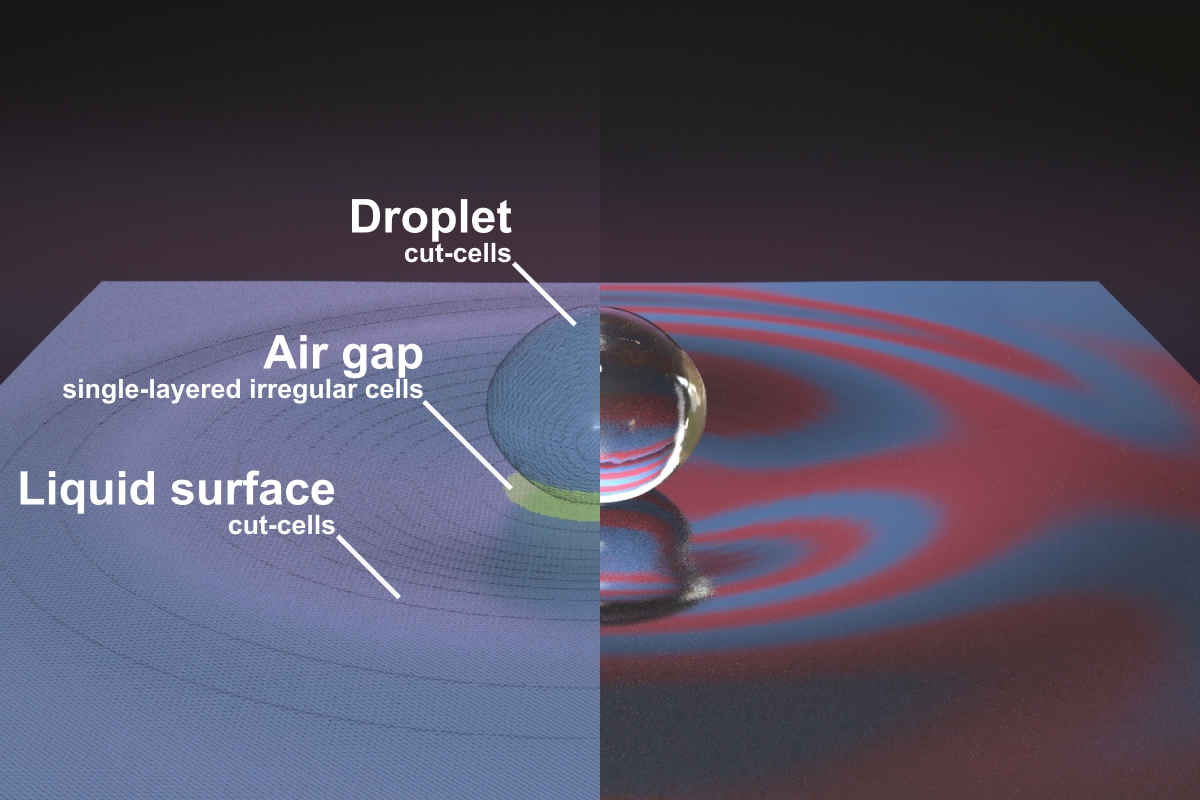 A Two-Way Coupling Approach for Simulating Bouncing DropletsHui Wang, Yuwei Xiao, Yankai Mao, Shiying Xiong, Xubo Yang, and Bo ZhuInternational Journal for Numerical Methods in Engineering, Sep 2024
This paper presents a two-way coupling approach to simulate bouncing droplet phenomena by incorporating the lubricated thin aerodynamic gap between fluid volumes. At the heart of our framework lies a cut-cell representation of the thin air film between colliding liquid fluid volumes. The air pressures within the thin film, modeled using a reduced fluid model based on the lubrication theory, are coupled with the volumetric liquid pressures by the gradient across the liquid-air interfaces and solved in a monolithic two-way coupling system. Our method can accurately solve liquid-liquid interaction with air films without adaptive grid refinements, enabling accurate simulation of many novel surface-tension-driven phenomena such as droplet collisions, bouncing droplets, and promenading pairs.
@article{wang2024walking, author = {Wang, Hui and Xiao, Yuwei and Mao, Yankai and Xiong, Shiying and Yang, Xubo and Zhu, Bo}, title = {A Two-Way Coupling Approach for Simulating Bouncing Droplets}, journal = {International Journal for Numerical Methods in Engineering}, year = {2024}, volume = {}, number = {}, keywords = {cut-cell, fluid-fluid contact, multiphase fluid, surface tension flow, thin film, walking droplet}, doi = {https://doi.org/10.1002/nme.7592}, url = {https://onlinelibrary.wiley.com/doi/abs/10.1002/nme.7592}, eprint = {https://onlinelibrary.wiley.com/doi/pdf/10.1002/nme.7592}, dimensions = {true}, } -
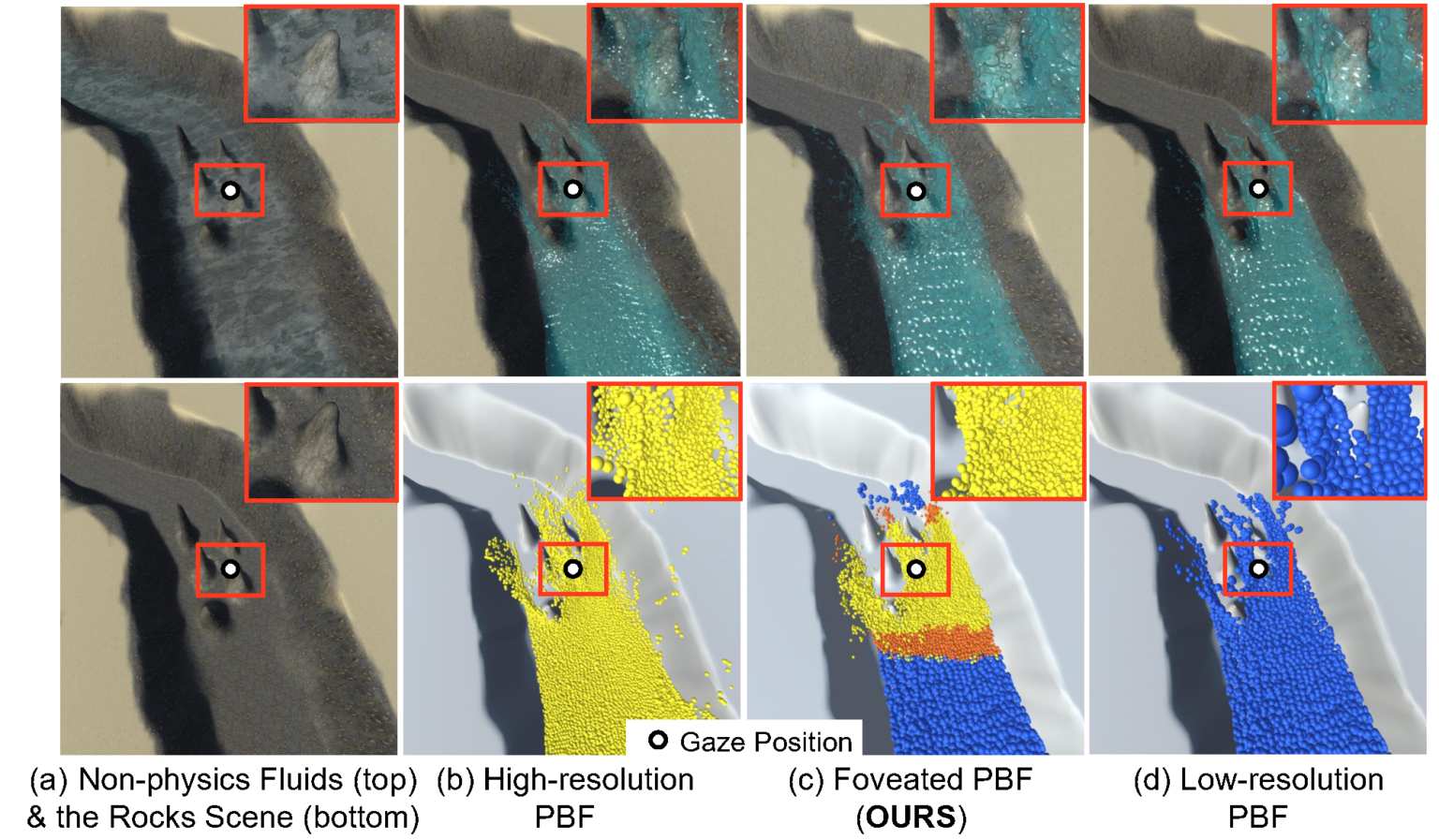 Foveated Fluid Animation in Virtual RealityWang Yue, Yan Zhang, Xuanhui Yang, Hui Wang, Dongxu Liu, and Xubo YangIn 2024 IEEE Conference Virtual Reality and 3D User Interfaces (VR), Mar 2024
Large-scale fluid simulation is widely useful in various Virtual Reality (VR) applications. While physics-based fluid animation holds the promise of generating highly realistic fluid details, it often imposes significant computational demands, particularly when simulating high-resolution fluid for VR. In this paper, we propose a novel foveated fluid simulation method that enhances both the visual quality and computational efficiency of physics-based fluid simulation in VR. To leverage the natural foveation feature of human vision, we divide the visible domain of the fluid simulation into foveal, peripheral, and boundary regions. Our foveated fluid system dynamically allocates computational resources, striking a balance between simulation accuracy and computational efficiency. We implement this approach using a multi-scale method. To evaluate the effectiveness of our approach, we have conducted subjective studies. Our findings show a significant reduction in computational resource requirements, resulting in a speedup of up to 2.27 times. It is crucial to note that our method preserves the visual quality of fluid animations at a level that is perceptually identical to full-resolution outcomes. Additionally, we investigate the impact of various metrics, including particle radius and viewing distance, on the visual effects of fluid animations. Our work provides new techniques and evaluations tailored to facilitate real-time foveated fluid simulation in VR, which can enhance the efficiency and realism of fluids in VR applications.
@inproceedings{wang2023foveated, author = {Yue, Wang and Zhang, Yan and Yang, Xuanhui and Wang, Hui and Liu, Dongxu and Yang, Xubo}, booktitle = {2024 IEEE Conference Virtual Reality and 3D User Interfaces (VR)}, title = {Foveated Fluid Animation in Virtual Reality}, year = {2024}, volume = {}, issn = {}, pages = {535-545}, keywords = {measurement;fluids;three-dimensional displays;virtual reality;user interfaces;animation;visual effects}, doi = {10.1109/VR58804.2024.00074}, url = {https://doi.ieeecomputersociety.org/10.1109/VR58804.2024.00074}, publisher = {IEEE Computer Society}, address = {Los Alamitos, CA, USA}, month = mar, dimensions = {true}, } -
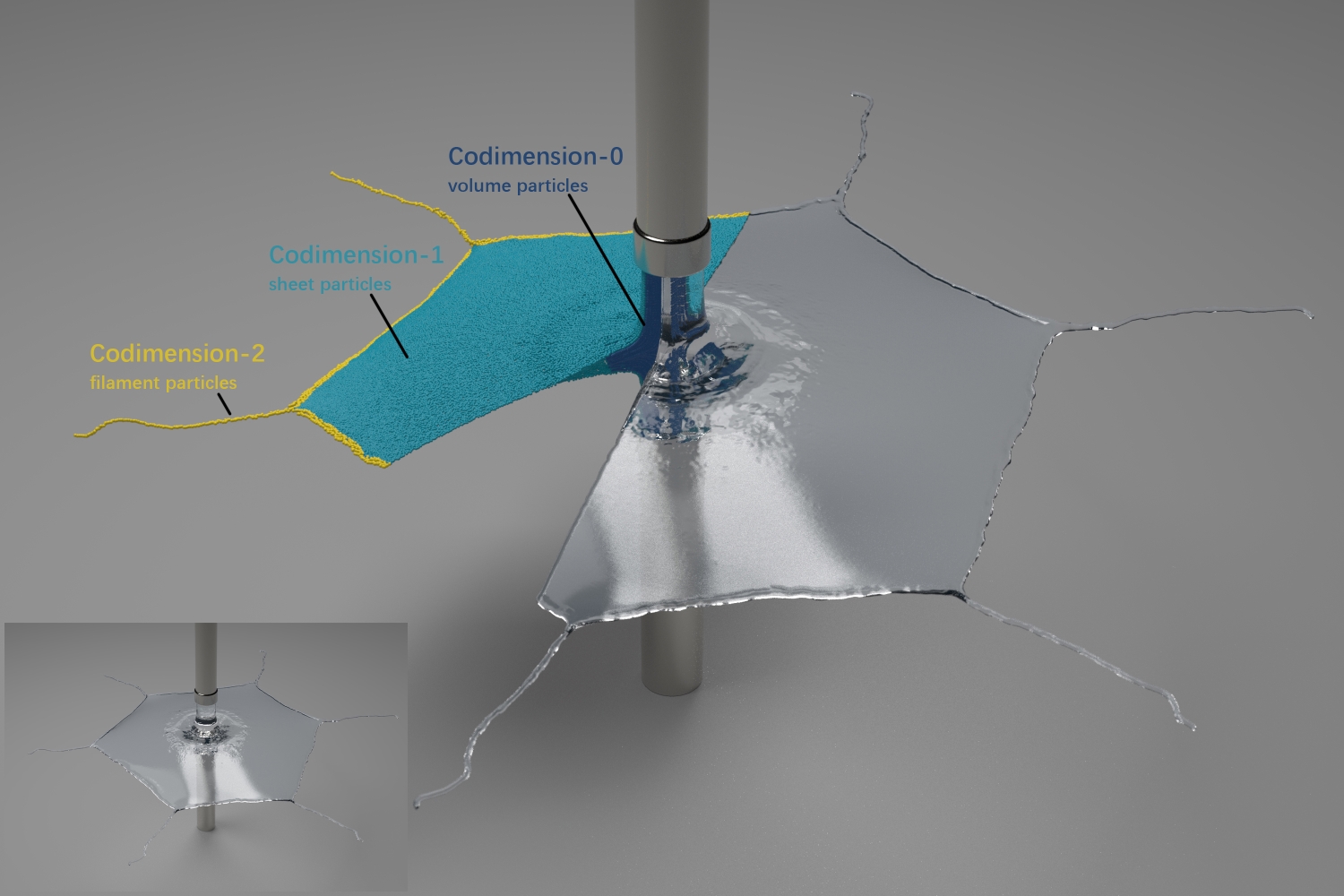 Codimensional Surface Tension Flow Using Moving-Least-Squares ParticlesHui Wang, Yongxu Jin, Anqi Luo, Xubo Yang, and Bo ZhuACM Trans. Graph. (Siggraph), Aug 2020
We propose a new Eulerian-Lagrangian approach to simulate the various surface tension phenomena characterized by volume, thin sheets, thin filaments, and points using Moving-Least-Squares (MLS) particles. At the center of our approach is a meshless Lagrangian description of the different types of codimensional geometries and their transitions using an MLS approximation. In particular, we differentiate the codimension-1 and codimension-2 geometries on Lagrangian MLS particles to precisely describe the evolution of thin sheets and filaments, and we discretize the codimension-0 operators on a background Cartesian grid for efficient volumetric processing. Physical forces including surface tension and pressure across different codimensions are coupled in a monolithic manner by solving one single linear system to evolve the surface-tension driven Navier-Stokes system in a complex non-manifold space. The codimensional transitions are handled explicitly by tracking a codimension number stored on each particle, which replaces the tedious meshing operators in a conventional mesh-based approach. Using the proposed framework, we simulate a broad array of visually appealing surface tension phenomena, including the fluid chain, bell, polygon, catenoid, and dripping, to demonstrate the efficacy of our approach in capturing the complex fluid characteristics with mixed codimensions, in a robust, versatile, and connectivity-free manner.
@article{wang2020codimensional, author = {Wang, Hui and Jin, Yongxu and Luo, Anqi and Yang, Xubo and Zhu, Bo}, title = {Codimensional Surface Tension Flow Using Moving-Least-Squares Particles}, year = {2020}, issue_date = {August 2020}, publisher = {Association for Computing Machinery}, address = {New York, NY, USA}, volume = {39}, number = {4}, issn = {0730-0301}, url = {https://doi.org/10.1145/3386569.3392487}, doi = {10.1145/3386569.3392487}, journal = {ACM Trans. Graph. (Siggraph)}, month = aug, articleno = {42}, numpages = {16}, keywords = {moving-least-squares, surface tension, codimensional fluids, PIC/FLIP}, dimensions = {true}, } -
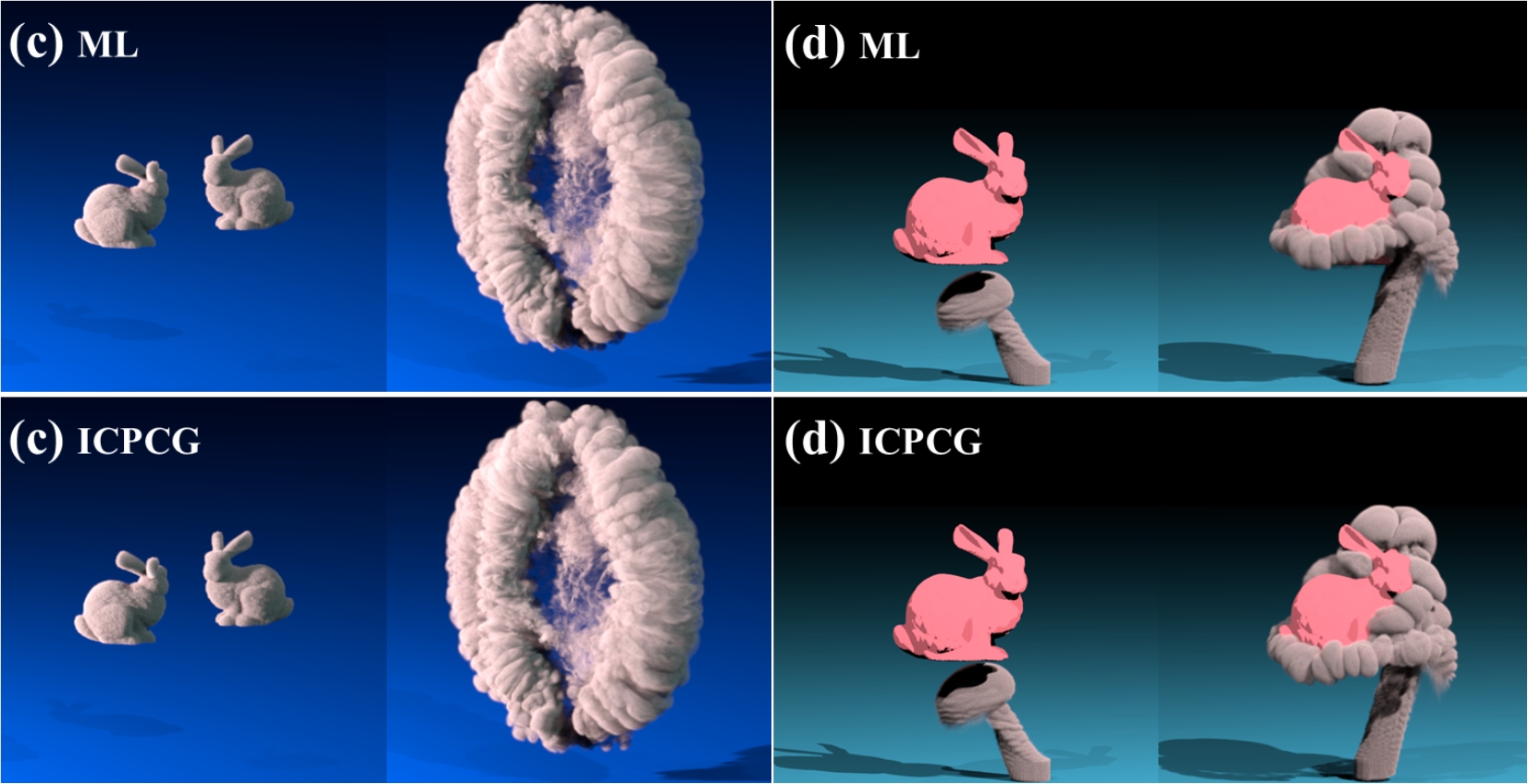 A Novel CNN-Based Poisson Solver for Fluid SimulationXiangyun Xiao, Yanqing Zhou, Hui Wang, and Xubo YangIEEE Trans. Vis. Comput. Graph., Aug 2020
Solving a large-scale Poisson system is computationally expensive for most of the Eulerian fluid simulation applications. We propose a novel machine learning-based approach to accelerate this process. At the heart of our approach is a deep convolutional neural network (CNN), with the capability of predicting the solution (pressure) of a Poisson system given the discretization structure and the intermediate velocities as input. Our system consists of four main components, namely, a deep neural network to solve the large linear equations, a geometric structure to describe the spatial hierarchies of the input vector, a Principal Component Analysis (PCA) process to reduce the dimension of input in training, and a novel loss function to control the incompressibility constraint. We have demonstrated the efficacy of our approach by simulating a variety of high-resolution smoke and liquid phenomena. In particular, we have shown that our approach accelerates the projection step in a conventional Eulerian fluid simulator by two orders of magnitude. In addition, we have also demonstrated the generality of our approach by producing a diversity of animations deviating from the original datasets.
@article{xiao2020novel, title = {A Novel CNN-Based Poisson Solver for Fluid Simulation}, author = {Xiao, Xiangyun and Zhou, Yanqing and Wang, Hui and Yang, Xubo}, journal = {IEEE Trans. Vis. Comput. Graph.}, year = {2020}, volume = {26}, number = {3}, pages = {1454-1465}, doi = {10.1109/TVCG.2018.2873375}, url = {https://ieeexplore.ieee.org/document/8478400}, dimensions = {true}, } -
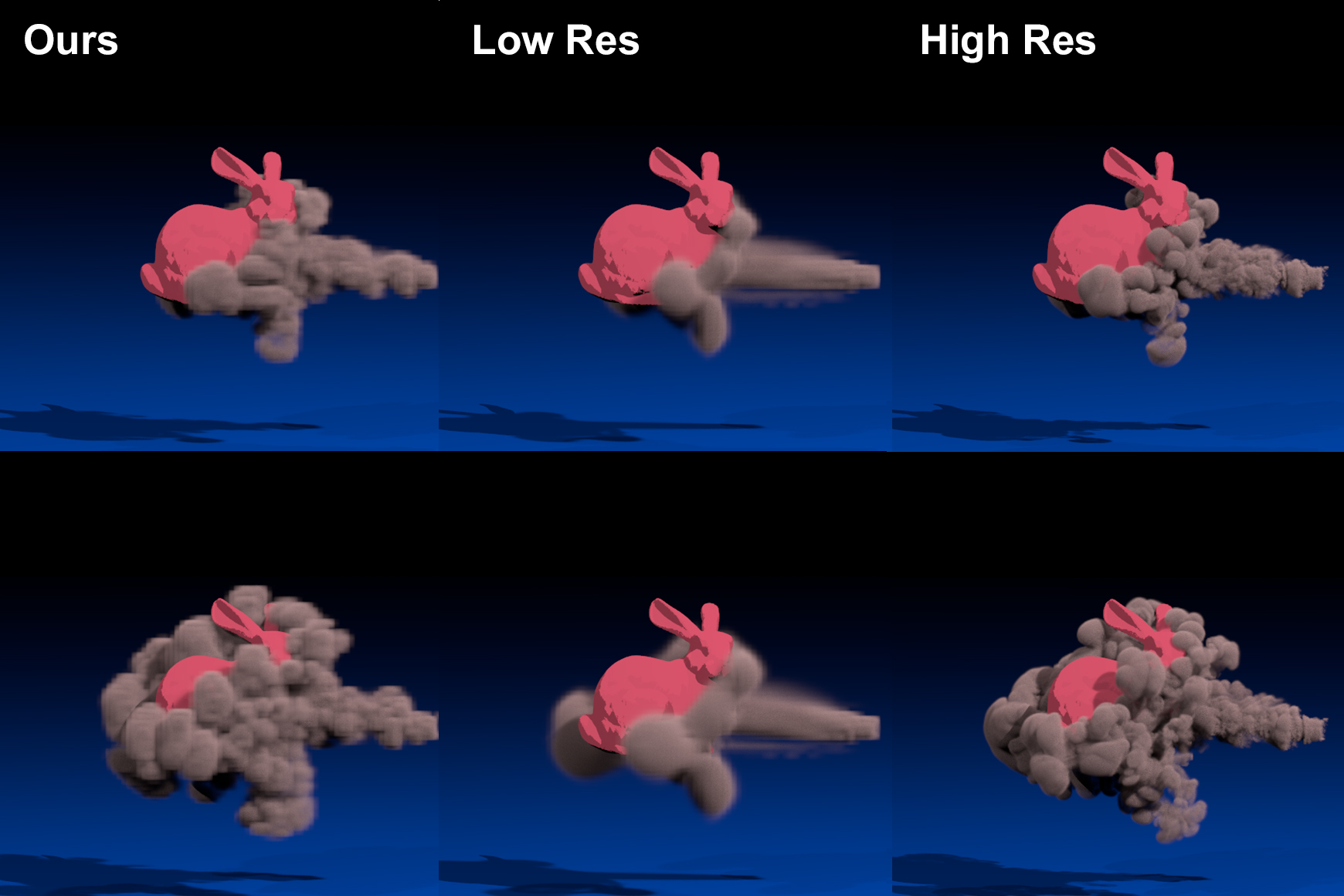 A CNN-based Flow Correction Method for Fast PreviewXiangyun Xiao, Hui Wang, and Xubo YangComput. Graph. Forum (Eurographics), Aug 2019
Abstract Eulerian-based smoke simulations are sensitive to the initial parameters and grid resolutions. Due to the numerical dissipation on different levels of the grid and the nonlinearity of the governing equations, the differences in simulation resolutions will result in different results. This makes it challenging for artists to preview the animation results based on low-resolution simulations. In this paper, we propose a learning-based flow correction method for fast previewing based on low-resolution smoke simulations. The main components of our approach lie in a deep convolutional neural network, a grid-layer feature vector and a special loss function. We provide a novel matching model to represent the relationship between low-resolution and high-resolution smoke simulations and correct the overall shape of a low-resolution simulation to closely follow the shape of a high-resolution down-sampled version. We introduce the grid-layer concept to effectively represent the 3D fluid shape, which can also reduce the input and output dimensions. We design a special loss function for the fluid divergence-free constraint in the neural network training process. We have demonstrated the efficacy and the generality of our approach by simulating a diversity of animations deviating from the original training set. In addition, we have integrated our approach into an existing fluid simulation framework to showcase its wide applications.
@article{xiao2019cnn,
  title = {A CNN-based Flow Correction Method for Fast Preview},
  author = {Xiao, Xiangyun and Wang, Hui and Yang, Xubo},
  journal = {Comput. Graph. Forum (Eurographics)},
  volume = {38},
  number = {2},
  pages = {431-440},
  year = {2019},
  doi = {10.1111/cgf.13649},
  url = {https://onlinelibrary.wiley.com/doi/abs/10.1111/cgf.13649},
  eprint = {https://onlinelibrary.wiley.com/doi/pdf/10.1111/cgf.13649},
  dimensions = {true},
}


